
Categories
Forest Fires: Can the Catastrophe Be Avoided?
Although it is still too early to assess the 2023 fire season, it can already be described as catastrophic. Fires are breaking out on every continent: forests are burning in Greece, Turkey, Spain and Russia. Canada and the United States are engulfed in flames. Fires in the Hawaiian archipelago (USA) became a disaster, with outbreaks on several islands at once: Maui, the Big Island and Hawaii. Several natural factors coincided here: heat, drought and hurricane-force winds. The fire on Maui claimed more than 100 lives, around 1,300 people were missing, and the burned area reached 850 hectares. As of mid-August 2023, Spain held Europe's grim record, with more than 71,000 hectares burned.
The Canary Islands were declared a disaster zone, where fires left around 12,000 people homeless. Large-scale forest fires have also been recorded in Russia. Fires are occurring in many regions of the country, affecting Siberia and the Far East on one side, and the North Caucasus and the Black Sea coast on the other. Satellite monitoring data are discouraging: the area affected by forest fires in the country is approximately 20% greater than in the same period last year. Experts offer bleak forecasts: by 2100, the number of forest fires worldwide could increase by 50%, spreading to new regions.

A forest fire cannot be controlled: it spreads rapidly either through the treetops (a crown fire) or through forest vegetation, mosses, lichens and the forest floor (a surface fire). Such fires are especially dangerous because winds cause them to change direction quickly and cover enormous areas within hours. Wildfires also know no national borders: consider the fire of 1825 that raged through the US state of Maine and the Canadian province of New Brunswick. More than 1 million hectares of forest burned, and towns were affected. Uncontrolled forest fires are clearly a global problem that requires joint efforts at both international and regional levels.
The intensity and frequency of forest fires increase year after year. Countries around the world suffer: plants, animals and people die. Yet just a hundred years ago, a forest fire was seen as a natural stage in an ecosystem's development that helped forests regenerate. What factors influence the scale of forest fires, and how can we reduce the harmful impact of wildfires on the environment?
I would like to point out that, because of abnormal weather in various regions in recent years, the fire season is starting earlier, lasting longer and threatening new areas: the danger arises in the first days of spring and does not subside until mid-autumn. For example, in 2022, a lack of rainfall in India led to the destruction of around 6,000 hectares of forest. Fires began as early as April because the rains ended in February, earlier than usual. Major forest fires are most often associated with dry thunderstorms, when lightning is accompanied by minimal rainfall. Persistent heat above 30°C and prolonged drought, with humidity below 40%, create the conditions for dry thunderstorms. On average, lightning strikes the ground more than 100,000 times a day: 10 to 20% of these electrical discharges can cause a fire.
Research shows that forest fires at northern latitudes, where conifers and peatlands predominate, are becoming an important indicator of climate change. These forests are most vulnerable to fires during dry weather that is unusual for these regions, because fallen needles generate enough heat for spontaneous combustion, while dry peat (with no more than 25% moisture during drought) begins to smolder, producing a great deal of smoke. This is how the flameless phase of a fire begins, which is dangerous because of its persistence: deep peat layers can smolder for years. Unlike crown and surface fires, a peat fire takes a long time to ignite and spread, making it difficult to detect and extinguish promptly.
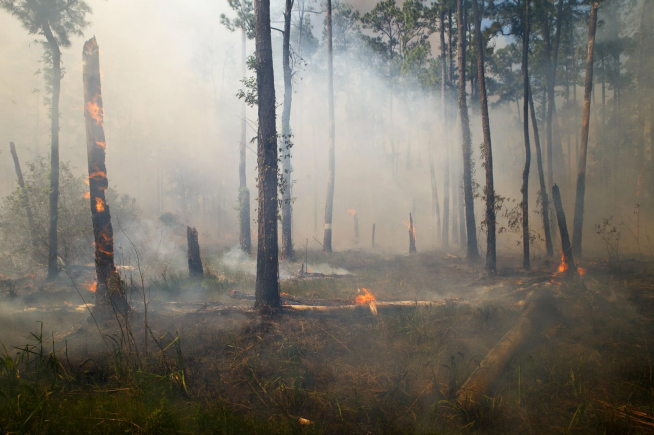
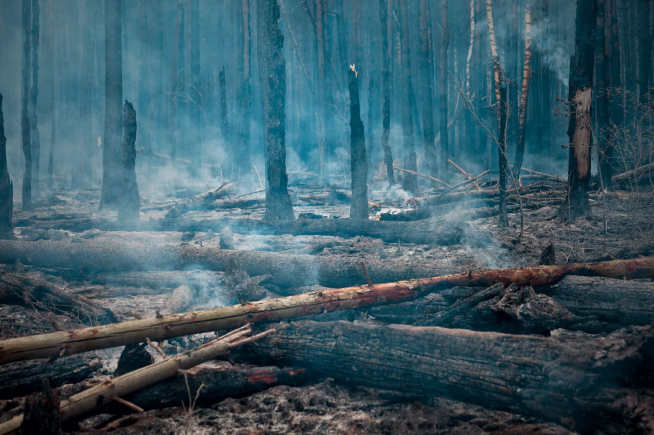
In addition to natural factors, human activity affects the growing area and intensity of forest fires. Careless handling of fire, a discarded cigarette butt or a stray spark from a campfire often causes a fire. Even litter left in a forest belt can lead to disaster: fragments of glass, for example, can act as a lens, focusing sunlight and igniting grass or dry leaves. There are also examples of deliberate burning: residents of suburbs and villages do not realize the danger of burning waste and last year's grass. According to statistics, 60% to 90% of fires are caused by deliberate human actions. Controlled burning, in turn, is considered one way to reduce the risk of fires spreading. But experience shows that its use can lead to tragedy. For example, in spring 2022 in New Mexico (USA), an error during a prescribed burn in a mountainous area destroyed forest and affected thousands of residents.
Forest fires can also have technological causes rooted in human activity. For example, in early August 2023, a broken power line near Gelendzhik in the Krasnodar Territory caused a fire covering 0.5 hectares. The fire was contained and did not have catastrophic consequences thanks to the effective action of forestry workers and firefighters.
The growing intensity and area of forest fires are symptoms of the global climate crisis. Alongside the death of animals and plants, smoke and air pollution are significant harmful consequences that damage human health. In turn, high concentrations of carbon dioxide, carbon monoxide and methane maintain high temperatures in the lower atmosphere and intensify the warming of the Earth's surface, accelerating global warming. Environmental specialists call for efforts to focus on studying and predicting fires and developing effective monitoring and rapid-response systems for natural disasters, because forest fires and climate change reinforce each other's harmful effects on the environment.
Restoring ecosystems is one effective way to prevent fires. Wetland restoration, for example, is especially important: it stops peatlands from drying out and restores regional biodiversity. In 2022, a fire that began in the Ryazan Region quickly spread to the Oka Nature Reserve and Meshchersky National Park, destroying around 13,000 hectares of forest in protected areas. To reduce the risk of such tragedies, peat extraction sites need to be monitored and sufficient attention paid to restoring natural ecosystems. Large-scale wetland rehabilitation and conservation work is underway in Belarus, where more than 50,000 hectares of previously drained peatlands have already been restored. In 2020, specialists there developed their own method for accelerated restoration of a fen and successfully applied it in the Lida District at the Dokukovskoye peat deposit.
Today, everyone can take part in reforestation: dedicated programs and services make it possible to plant a tree and watch it grow. Environmental organizations provide access to information about individual plants and reports on their development. Specialists select planting locations, and seedlings receive professional care, helping them take root and survive.
Environmentalists around the world insist that ESG principles must be implemented at both public and private levels, because climate change needs to be slowed before it becomes irreversible. Environmental initiatives to reduce the pace of global warming must be carried out systematically and consistently. Governments bear responsibility for environmental protection, but environmental projects cannot succeed without comprehensive support from society and business. Companies, regardless of their size, understand the need for sustainable development and strive to conserve natural resources, assessing environmental indicators such as their carbon footprint alongside financial and production performance. To reduce their environmental impact, brands invest in conservation measures and the development of safer production. But I would like to emphasize that minimizing human-caused risks of forest fires is a task for every one of us, as well as for governments and businesses. Anyone can follow basic rules outdoors: avoid lighting fires in forests during the fire season, which peaks in summer, and keep forest belts and roadsides clean by collecting litter. Every person on the planet must recognize their responsibility to the future and reduce their harmful impact on the planet's ecosystems. Taking part in reforestation after fires is another excellent example of personal responsibility.


